Bed Bug Exterminator Grand Prairie TX — Prevention, Detection & Why Every Day You Wait Costs More
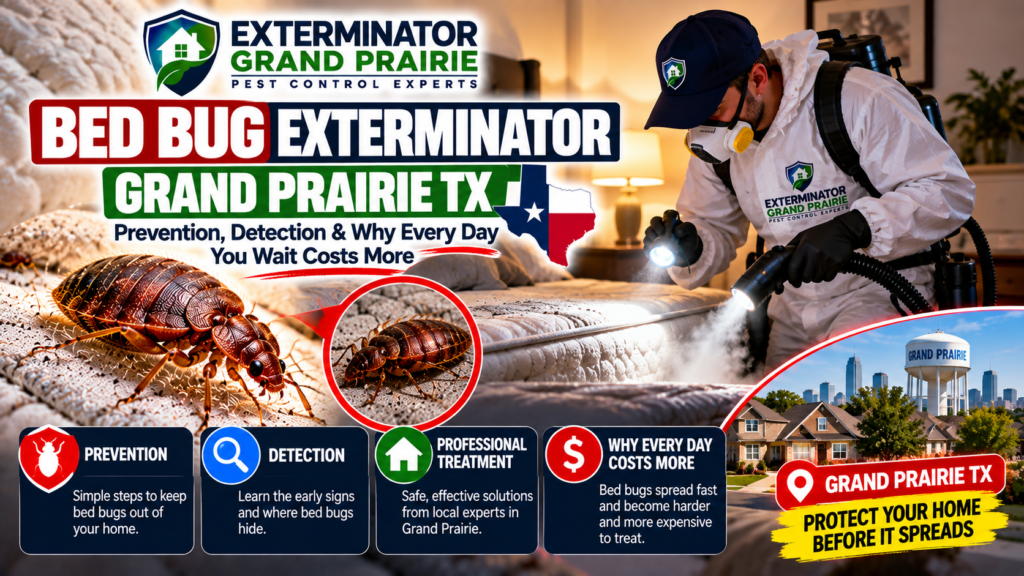
Bed bugs don’t resolve on their own. They don’t slow down unless temperatures drop below 50°F. And they don’t stay in one room — a single infested mattress becomes a whole-home problem within months. This guide covers everything Grand Prairie TX homeowners need to know about preventing, detecting, and eliminating bed bugs before a small problem becomes a catastrophic one. Read it — then call us. The sooner you act, the less this costs.
The Complete Guide to Bed Bug Prevention in Grand Prairie TX
The most cost-effective bed bug strategy is prevention. A confirmed infestation costs $400–$2,500 to eliminate. Prevention costs a fraction of that. Here’s exactly what Grand Prairie TX homeowners should do to keep bed bugs out permanently.
Travel Smart — The #1 Entry Point
Hotels, motels, and short-term rentals across the DFW Metroplex are the leading source of residential bed bug introductions. Before sleeping in any rental accommodation: pull the mattress back from the headboard and inspect the seams under a flashlight, check behind the headboard for dark fecal spots, and store your luggage on the metal luggage rack — never on the bed or carpet. When you return home, unpack directly into the washer on hot and dry on high heat for 30 minutes. This single habit eliminates the most common introduction pathway.
Never Accept Used Mattresses or Upholstered Furniture
Free curbside mattresses, Facebook Marketplace sofas, and estate sale furniture are a leading source of bed bug introductions across Grand Prairie, Arlington, and Duncanville neighborhoods. Bed bugs survive inside furniture seams and frame joints for up to 12 months without feeding — you cannot visually confirm safety. The only safe approach: buy mattresses and upholstered furniture new, or have secondhand pieces professionally heat-treated before they enter your home.
Install Mattress Encasements Today
Bed-bug-certified zippered mattress and box spring encasements do two things: they trap any existing bugs inside (where they eventually die) and they eliminate seams on the exterior surface where new bugs would hide. Encasements cost $30–$80 and are available at major retailers. For Grand Prairie TX families with children, encasements on every bed in the home are the single highest-value prevention investment available.
Reduce Clutter — Especially in Bedrooms
Clutter multiplies available harborage sites, making early detection harder and treatment more expensive. Books, boxes, clothing piles, and storage items near beds give bugs dozens of places to hide beyond the mattress. A bedroom with minimal clutter is treated in one visit at standard cost. A heavily cluttered room requires 2–3× the time, product, and follow-up visits — at 2–3× the cost.
Inspect After Guests and After Moving
Any time a guest has stayed in your Grand Prairie home, or any time you’ve moved into a new property or brought items from another location, inspect the guest bedroom mattress seams and surrounding baseboards within 72 hours. The earlier a single introduced bug is caught, the simpler the resolution. One bug can be managed with targeted spot treatment. Fifty bugs require a room-wide chemical program. Five hundred bugs require heat treatment of the entire home.
Schedule Annual Professional Inspections
For homeowners who travel frequently, host guests regularly, or live in multi-unit buildings in Grand Prairie TX, an annual professional inspection is the most reliable prevention layer available. Our technicians inspect areas a homeowner typically misses — behind baseboards, inside electrical outlets, in headboard joints — and can catch early-stage infestations before they self-sustain. Call (972) 755-0755 to schedule a preventive inspection today.
Bed Bug FAQs Every Texas Homeowner Should Know
These are the questions we hear most from Grand Prairie, Arlington, Mansfield, Cedar Hill, Irving, and Duncanville homeowners — answered directly so you can make informed decisions fast.
Q: Will bed bugs go away if I ignore them?
No. Bed bugs have no natural predators inside a home and a reliable food source (you). A colony left untreated doubles in size every 16 days under favorable conditions. There is no scenario in which an untreated infestation self-resolves indoors.
Q: Can I treat bed bugs myself with store products?
Rarely successfully. Consumer sprays, “bombs,” and powders fail against established infestations for two reasons: they don’t reach deep harborage sites, and they don’t kill eggs. Many Grand Prairie homeowners spend $150–$300 on DIY products that suppress surface bugs while the egg population hatches and the infestation rebuilds within 3–4 weeks. Professional treatment eliminates the problem; consumer products typically delay it.
Q: Do I have to throw away my mattress?
No — and you shouldn’t. Discarding a mattress without treating the room leaves all other harborage sites intact. Bugs already in the box spring, headboard, and baseboards will simply colonize new furniture. Professional heat treatment eliminates bed bugs from mattresses without discarding them. Encasements protect treated mattresses from re-infestation.
Q: How much does professional bed bug treatment cost in Grand Prairie TX?
Chemical treatment: $200–$400 per room, 2–3 visits required. Whole-home heat treatment: $1,000–$2,500, typically one visit. The right treatment depends on infestation severity, number of rooms affected, and whether eggs are confirmed. We provide a written estimate after a free inspection — call (972) 755-0755 to schedule.
Q: How quickly can you treat my home?
Same day. We provide same-day inspection across Grand Prairie, Arlington, Mansfield, Irving, Duncanville, and Cedar Hill TX. In confirmed cases with immediate treatment authorization, same-day treatment is available for chemical programs. Heat treatment is typically scheduled within 24–48 hours. Call (972) 755-0755 to get started today.
Q: Are bed bugs covered by my homeowner’s insurance?
Standard homeowner’s policies in Texas typically exclude pest infestations as a “maintenance issue.” However, secondary damage caused by bed bugs — stained mattresses, ruined upholstery — may qualify for a claim depending on your specific policy. Document all damage with photos before treatment begins and contact your insurer to ask about coverage specifics.
Q: Is heat treatment safe for my home and belongings?
Professional heat treatment uses specialized equipment that heats a room to 120–135°F — hot enough to kill all bed bug life stages but below temperatures that damage standard home furnishings, electronics, or structural elements. Certain heat-sensitive items (candles, vinyl records, pressurized cans, medications) are removed before treatment. Our technicians provide a full pre-treatment checklist at the inspection visit.
Can Bed Bugs Live in Carpet?
Yes — and carpet is one of the most commonly overlooked harborage sites in Grand Prairie TX homes. While carpet is not a primary harborage (bed bugs strongly prefer the tight, stable hiding spots in mattress seams and headboard joints), carpet near the bed and along baseboards becomes a secondary harborage as an infestation grows.
Where in the Carpet They Hide
Bed bugs in carpet concentrate in the carpet fibers along the wall-to-floor edge (the “carpet tack strip zone”), directly under and around the bed, and in any area of carpet that is rarely moved or vacuumed. They do not live in the middle of open floor areas — they need the edge, wall, or furniture contact that provides cover.
Why Carpet Makes Infestations Harder to Treat
Consumer sprays applied to carpet surfaces don’t penetrate to where bugs shelter near the base of the carpet pile. Vacuuming removes surface bugs and eggs but misses those deeper in the pile and along edges. Professional treatment of carpeted rooms requires a combination of residual insecticide application to carpet edges and baseboard zones, plus treatment of all other harborage sites in the room. Steam cleaning with a commercial steamer (sustained 160°F+ at the surface) kills bugs on contact in carpet but requires careful technique to reach harborage zones. If carpet in your bedroom is showing fecal spots or you’re finding shed skins along the wall edge, call (972) 755-0755 immediately — carpet infestation indicates a more established colony than a mattress-only finding.
Professional Treatment for Carpeted Rooms
Heat treatment is particularly effective in carpeted rooms because heat penetrates through the entire carpet pile, killing bugs at every depth in a single treatment. For Grand Prairie TX homeowners with carpeted bedrooms and an established infestation, heat treatment is strongly recommended over chemical treatment for carpeted spaces.
Can Bed Bugs Live Behind Wallpaper?
Yes — and this is one of the reasons why DIY treatment and even professional chemical treatment sometimes fails to achieve complete elimination. Behind wallpaper is a textbook deep harborage site: dark, undisturbed, directly adjacent to the sleeping area, and completely inaccessible to surface spray applications.
How Bed Bugs Get Behind Wallpaper
In older Grand Prairie TX homes with aging wallpaper, lifting or bubbling edges along seams near the headboard wall provide direct access to the void between wallpaper and drywall. Bed bugs — which can compress through a gap as thin as a credit card — exploit these openings readily. Once behind the wallpaper, they establish a harborage that is invisible, temperature-stable, and protected from surface treatments.
Signs of Behind-Wallpaper Infestation
Dark fecal streaking or staining visible through or along the edges of wallpaper seams near the headboard. Faint musty odor emanating from the wall surface rather than the mattress. Continued re-infestation of the mattress despite repeated treatments — a strong sign of a persistent harborage source in the wall.
Why This Matters for Treatment Selection
Chemical sprays cannot penetrate behind intact wallpaper. Dust applications (like diatomaceous earth or professional insecticidal dusts) can be injected behind lifted edges, but only if those edges are accessible. Heat treatment, however, penetrates walls — the heat raises the temperature behind wallpaper along with the rest of the room, eliminating this harborage site that chemical treatment misses entirely. For any Grand Prairie TX home with wallpaper in the bedroom and a recurring or persistent infestation, heat treatment is the only reliable solution. Call (972) 755-0755 to discuss heat treatment options today.
How Early Bed Bug Detection Reduces Treatment Costs — And Why You Should Act This Week
This is the most important section in this guide. The relationship between bed bug infestation stage and treatment cost is exponential, not linear. Acting one month sooner can save Grand Prairie TX homeowners hundreds to thousands of dollars.
Stage 1: 1–15 Bugs (Week 1–3 After Introduction)
At this stage, the infestation is typically confined to the mattress seams and immediate headboard area. Treatment is a targeted single-room chemical application — cost: $150–$250. One or two visits. Problem resolved.
Stage 2: 15–100 Bugs (Month 1–2)
The colony has begun spreading to the box spring interior, nightstand, and nearby baseboards. Full room chemical treatment required — cost: $250–$500. Two to three visits over 4–6 weeks. Success rate high with compliance.
Stage 3: 100–1,000 Bugs (Month 2–4)
The infestation has spread to secondary furniture, carpet edges, electrical outlets, and potentially adjacent rooms. Whole-room or multi-room chemical treatment, or targeted heat — cost: $500–$1,500. Three to four visits minimum. Some items may need to be discarded.
Stage 4: 1,000+ Bugs (Month 4+)
Whole-home infestation. Bugs throughout all sleeping areas, living room furniture, carpet, walls. Whole-home heat treatment required — cost: $1,500–$2,500+. Possible attic treatment, possible multiple heat sessions, certain items unrecoverable. Significant disruption to the household for days.
The Calculation Is Simple
A Stage 1 infestation caught this week costs $150–$250 and two visits to resolve. The same infestation caught three months from now costs $1,500–$2,500 and requires a whole-home heat day. The bug that bit you last night is not going away by itself. Call (972) 755-0755 for a same-day inspection in Grand Prairie, Arlington, Mansfield, Irving, Duncanville, or Cedar Hill TX. Do it today.
Bed Bug Life Cycle Explained — Why They’re So Hard to Eliminate Without Professional Help
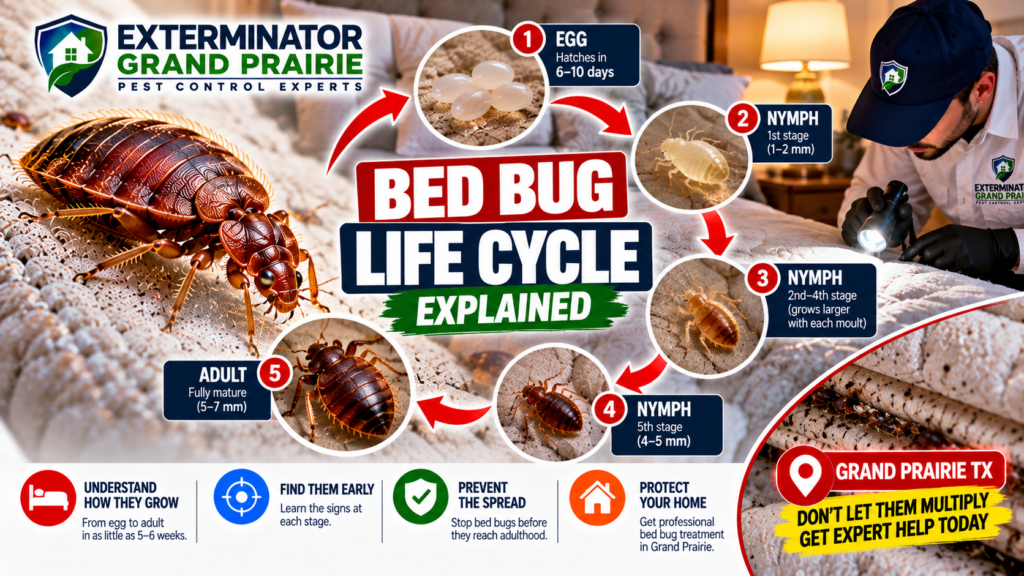
Understanding the bed bug life cycle explains why DIY products fail and why professional treatment must address all life stages — not just adult bugs.
The 5 Stages
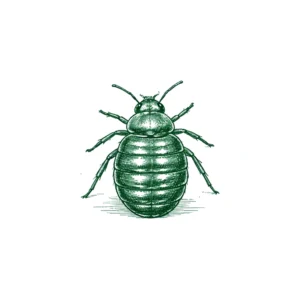
Egg: Pearl-white, 1mm, glued to surfaces with a cement-like secretion. Hatch in 6–10 days at room temperature. Invisible to the naked eye without magnification and a flashlight. Consumer sprays do not kill eggs — this is the primary reason DIY treatment fails.
1st Instar Nymph: Hatches at 1.5mm, nearly transparent. Immediately seeks a blood meal to molt. At this stage, they are almost impossible to detect visually and are already feeding and growing.
2nd–4th Instar Nymphs: Progressively larger and darker with each molt (five molts total before adulthood). Each molt requires a blood meal. Development from egg to adult takes 5–6 weeks under favorable conditions (75–80°F, regular host access).
Adult: Reddish-brown, apple-seed sized, fully reproductive. Females begin laying 1–5 eggs per day within 3–4 days of the first blood meal. Adults live 6–12 months. A female produces 200–500 eggs in her lifetime.
Why Standard Sprays Fail
Most consumer insecticides labeled for bed bugs are contact killers — they kill adult bugs on direct contact but degrade within days on surfaces. They have no ovicidal (egg-killing) activity. This means 7–10 days after any spray treatment, a new generation hatches from untouched eggs and begins feeding and reproducing. Without follow-up treatment timed to the egg hatching cycle, the infestation rebuilds to its pre-treatment population within 3–4 weeks. Professional treatment protocols account for the life cycle — timed follow-up visits at 10–14 day intervals interrupt the egg-to-reproductive cycle before re-establishment. Heat treatment eliminates all life stages simultaneously, bypassing the cycle entirely.
What This Means for You
Every 16 days, an untreated colony can double in size. If you’ve noticed signs of bed bugs in your Grand Prairie TX home, the colony is already larger than what you can see. Early professional intervention disrupts the cycle before it compounds. Call (972) 755-0755 today — same-day inspection available across Grand Prairie, Arlington, Mansfield, Irving, Duncanville, and Cedar Hill TX.
Why Ignoring Bed Bugs Makes the Problem Dramatically Worse — And What It Actually Costs You
This section is for Grand Prairie TX homeowners who found one bug, or noticed a few bites, and are thinking “let’s wait and see.” This is the most expensive decision you can make.
The Infestation Timeline
Week 1: You find a bug on the mattress. Population: ~5–15. Easy to treat. Low cost.
Month 1: You’re still “watching it.” Population: ~50–100. First eggs from that original female are now adults and laying their own eggs. Treatment cost has doubled.
Month 2: Bites are nightly. The sofa now has bugs in the seams. Your teenager mentions their room has them too. Population: 300–500+. Whole-home chemical program required.
Month 3: Multiple rooms infested. Bugs behind outlets, under carpet edges, possibly in the walls. Population: 1,000–5,000. Heat treatment for the entire home required. Possibly 2 sessions. $2,000–$3,000.
The Hidden Costs Beyond Extermination
Prolonged infestations generate costs that extend far beyond the extermination bill. Ruined mattresses and box springs that must be replaced: $300–$1,500. Upholstered furniture that cannot be treated: $500–$3,000. Time off work for treatment visits and preparation: significant. Mental health impact — anxiety, sleep deprivation, and the psychological toll of an unresolved infestation in your bedroom is documented and real. Medical costs if a family member develops an allergic reaction to repeated bites.
The Neighborhood Risk
Bed bugs don’t stay in one house forever. Infested items placed for curbside pickup spread bugs to neighbors. Visitors to your Grand Prairie home carry bugs home with them without knowing. If your home is in a townhome or apartment complex in Arlington, Irving, or Grand Prairie, an unresolved infestation in your unit actively puts neighboring units at risk — and your neighbors’ management companies or landlords may hold you liable.
What Happens When You Call Us Today Instead
A same-day inspection confirms whether you have bed bugs, identifies the stage of infestation, and gives you a written estimate with treatment options and pricing. For Stage 1 and Stage 2 infestations — the majority of calls we receive — treatment is completed within days at a fraction of the cost of a delayed response. The call takes two minutes. The alternative costs thousands.
Grand Prairie TX residents and surrounding communities: call (972) 755-0755 right now. Same-day inspection. Free estimate. Licensed technicians serving Grand Prairie, Arlington, Mansfield, Irving, Duncanville, Cedar Hill, DeSoto, Lancaster, Midlothian, and all surrounding DFW communities.
Stop the Infestation Before It Gets Worse
Same-day bed bug inspection and treatment across Grand Prairie, Arlington, Mansfield, Irving, Duncanville, Cedar Hill, and all DFW communities. Licensed, insured, and locally trusted.
Free Inspection · Written Estimate · Same-Day Service Available
Serving Grand Prairie TX and All Surrounding Neighborhoods
We provide same-day bed bug inspection and treatment throughout the entire DFW Southwest service area: Grand Prairie (including Dalworth Park, Fish Creek, and Highland Hills), Arlington (including South Arlington, Pantego, and Dalworthington Gardens), Mansfield, Irving (including Valley Ranch and Las Colinas), Duncanville, Cedar Hill, DeSoto, Lancaster, Midlothian, Kennedale, Burleson, and all surrounding DFW communities. If you’re within the 972 or 817 area codes, we’re likely in your neighborhood already. Call (972) 755-0755.
Related Pest Control Services in Grand Prairie TX
- Bed Bug Control Grand Prairie TX — Heat Treatment & Chemical Treatment
- Complete Bed Bug Guide: Signs, Bites, Hiding Spots & Costs
- General Pest Control Grand Prairie TX
- Spider Control Guide for Grand Prairie TX
- Fall Pest Prevention for Grand Prairie TX Homes
Frequently Asked Questions — Bed Bug Prevention & Treatment Grand Prairie TX
What is the fastest way to get rid of bed bugs in Grand Prairie TX?
Whole-home heat treatment is the fastest method — it eliminates all life stages including eggs in a single 6–8 hour session. Chemical treatment requires 2–3 visits over 4–6 weeks. For Grand Prairie TX homeowners who need the problem resolved quickly — before a lease transfer, a property sale, or guests arriving — heat treatment is the right choice. Call (972) 755-0755 for same-day scheduling.
How do I know if the bed bugs are in my carpet?
Check carpet edges along the wall line directly around and under the bed with a flashlight. Look for dark fecal spots on the carpet pile or along the baseboard, shed skins near the carpet tack strip, and small reddish-brown bugs moving near the wall edge. If you’re finding these signs in carpet rather than just on the mattress, the infestation is more established than Stage 1 — call (972) 755-0755 for an immediate inspection.
Can bed bugs get inside walls in Grand Prairie TX homes?
Yes — through electrical outlets, plumbing penetrations, cracks in baseboards, and behind wallpaper. Once bugs establish harborage inside walls, chemical surface sprays can’t reach them. Heat treatment is the only reliable solution for wall harborage. This is why recurring infestations that don’t respond to repeated spray treatments are often a wall or wallpaper harborage problem.
How long does it take for a bed bug infestation to get severe?
Under typical Grand Prairie TX home conditions (70–80°F, regular human host), a population can double every 16 days. An infestation introduced in May can be severe by August. By the time most homeowners seek professional help, the infestation is already at Stage 2 or Stage 3. If you noticed any signs of bed bugs — a bite, a spot, a bug — call immediately rather than waiting to confirm further.
Does bed bug prevention require professional help, or can I do it myself?
Prevention is largely DIY: travel hygiene, mattress encasements, avoiding secondhand upholstered furniture, and inspecting guest rooms after visits. The professional contribution to prevention is annual inspection — a trained technician finds early-stage infestations that homeowners miss. For a Grand Prairie TX household that travels frequently or has high guest traffic, an annual inspection is the highest-ROI prevention investment available.