TLDR; Wasp Control Grand Prairie TX
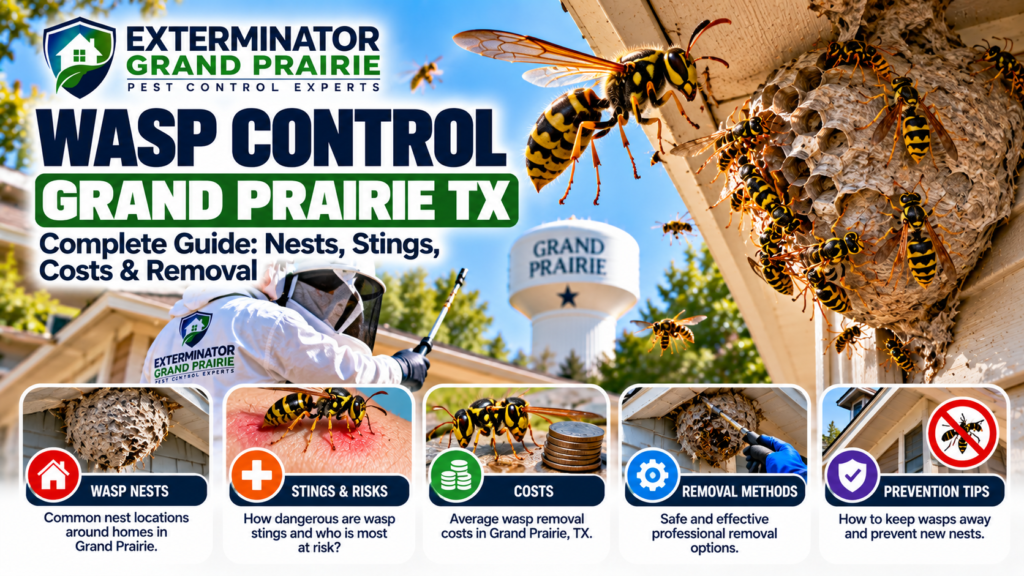
Wasps are one of the most common and dangerous pest problems for Grand Prairie TX homeowners, especially from late summer through October. This complete guide answers every question about wasps — from what attracts them to your property, to how much removal costs, to whether their stings require medical care. If you have an active wasp problem right now, call (972) 755-0755 for same-day service.
What Attracts Wasps to Your Property?
Wasps are drawn to Grand Prairie TX properties by a combination of food sources, nesting sites, and environmental conditions. Understanding what attracts them is the first step to keeping them away.
Food Sources
Wasps are omnivores. In spring and early summer, they hunt protein — insects, caterpillars, and meat scraps from outdoor grills and garbage bins. In late summer and fall, colonies shift to seeking sugar: ripe fruit, sweet drinks, hummingbird feeders, and open soda cans. If wasps are swarming your patio or outdoor dining area, a food source is within 300 feet.
Nesting Sites
Wasps look for sheltered, protected cavities with low foot traffic — under eaves, inside wall voids, in attic spaces, under decks, in ground burrows, and inside hollow trees. Properties with overhanging eaves, older wood siding, and landscaped yards with ground cover provide ideal nesting habitat.
Water Sources
Wasps need water to build their paper nests and regulate colony temperature. Birdbaths, leaky hoses, puddles near irrigation systems, and pool edges attract wasps looking for moisture.
Existing Nest Pheromones
Even after a nest is removed, chemical pheromones left on surfaces attract new queens the following spring. This is why wasps return to the same spots year after year. Professional treatment neutralizes these attractant chemicals.
How Much Does Wasp Nest Removal Cost in Texas?
Wasp nest removal in Texas typically costs $100 to $400 for a standard residential job. Here’s what affects the price in Grand Prairie:
Factors That Affect Wasp Removal Cost
Nest location: Accessible nests under eaves cost less ($100–$150). Hidden nests inside wall voids, attic spaces, or underground burrows cost more ($200–$400) due to the additional labor and materials required.
Nest size and colony population: A small paper wasp nest with 20–50 workers is straightforward. A large yellow jacket colony with 5,000–15,000 workers requires more product and takes more time.
Number of nests: Multiple nests on one property are typically discounted — the inspection cost is shared across all locations.
Emergency or same-day service: Wasp stings are a medical emergency risk. Same-day service is available in Grand Prairie at no additional cost. Call (972) 755-0755 for a free estimate.
DIY vs Professional Wasp Removal Cost
Consumer wasp sprays cost $8–$15 per can but are rarely sufficient for large or hidden colonies. Attempting to treat a wall void nest without professional equipment can cause wasps to chew through interior walls and enter your living spaces — a far more costly problem. Professional one-time treatment with a warranty is nearly always the better value.
Wasp vs Bee: How to Tell the Difference
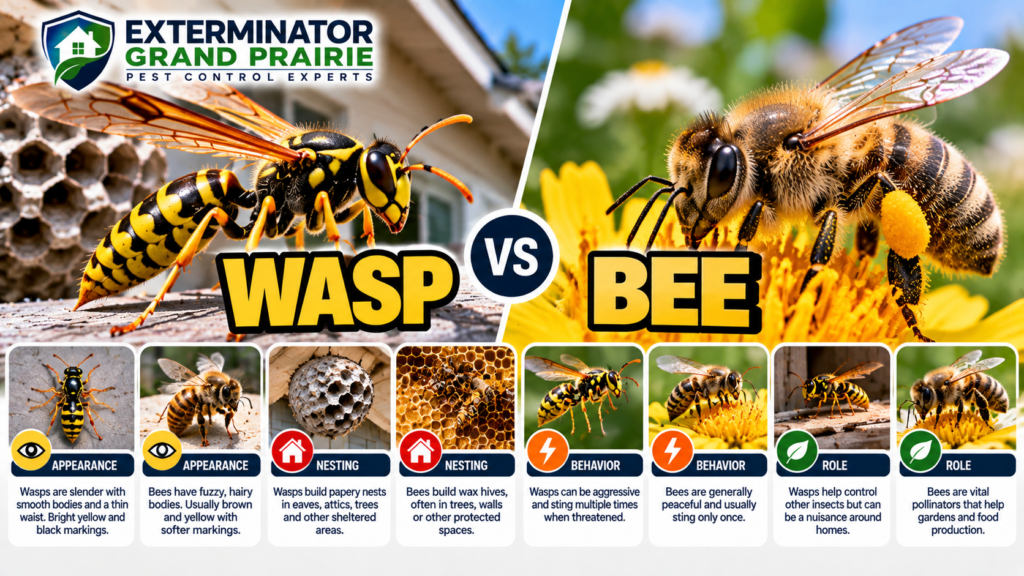
Wasps and bees are frequently confused, but they look and behave very differently — and the distinction matters for treatment.
Physical Differences
Wasps have a narrow, pinched waist between the thorax and abdomen, smooth shiny bodies with little to no hair, and bright yellow and black banding with a slender appearance. Their legs hang down in flight.
Bees are stockier and rounder with a fuzzy, hairy body designed to collect pollen. Honeybees are golden-brown. Bumblebees are large and fuzzy with yellow and black bands.
Behavioral Differences
Bees are generally non-aggressive unless their hive is directly disturbed. Wasps — particularly yellow jackets — are aggressive foragers that will sting with little provocation, especially in late summer. Bees can only sting once; wasps can sting multiple times.
Which Is on Your Property?
If they’re building a papery, comb-like nest — it’s wasps. If they’re entering and exiting a structure carrying yellow pollen — it’s likely bees. Both situations warrant a professional inspection to determine the correct treatment approach. Call (972) 755-0755 for a free identification visit.
Yellow Jackets vs Paper Wasps: What’s the Difference?
These are the two most common wasp species in Grand Prairie TX, and they behave very differently.
Yellow Jackets
Yellow jackets are the most dangerous wasp in Texas. They are stocky, with bold yellow and black banding, and extremely aggressive defenders of their nest. Yellow jackets nest in the ground, inside wall voids, and in structural cavities. Colonies can number 5,000–15,000 workers by September. They forage aggressively for protein and sugar, which brings them into conflict with people at outdoor events. They can sting dozens of times in seconds when disturbed.
Paper Wasps
Paper wasps are slender with long, dangling legs and an orange-tipped abdomen. They build the distinctive open, umbrella-shaped combs commonly found under eaves, fence rails, and playsets. Colonies are smaller — 20 to 75 workers — and paper wasps are less aggressive than yellow jackets unless their nest is directly threatened. They still sting and their venom can cause severe allergic reactions.
Treatment Difference
Paper wasp nests under eaves can sometimes be treated at dusk with a jet wasp spray. Yellow jacket nests in wall voids or underground require professional dust injection — consumer products are rarely sufficient and can make the problem worse by driving the colony deeper.
Hornets vs Wasps: Key Differences
Hornets are technically a subset of wasps, but the term is used specifically for larger species. In Grand Prairie TX, the most relevant hornet is the bald-faced hornet.
Bald-Faced Hornets
Despite the name, bald-faced hornets are a type of yellow jacket. They build large, football-shaped paper nests — often grapefruit to basketball size — in trees, shrubs, on buildings, and in attic spaces. They are extremely aggressive and will defend their nest up to 15 feet away. A disturbed bald-faced hornet colony requires immediate professional treatment. Never approach a bald-faced hornet nest without professional protective equipment.
Size Difference
Hornets are generally larger than common wasps. Bald-faced hornets are 5/8 to 3/4 inch long — noticeably larger than paper wasps. European hornets (less common in Texas) can reach 1.5 inches.
Where Do Wasps Build Their Nests?
Grand Prairie TX wasp nests are found in a wide range of locations depending on species:
Above-Ground Nests
- Under eaves and overhangs — the most common location for paper wasps
- Inside attic vents and gable vents
- Inside and around window frames
- Under deck boards and porch railings
- In trees and shrubs — bald-faced hornets and some paper wasps
- Inside wall voids — yellow jackets frequently chew through siding into walls
- Inside unused grills, mailboxes, and outdoor furniture
Underground Nests
Yellow jackets are the primary species nesting underground in Grand Prairie. They use abandoned rodent burrows and expand them significantly. Ground nests are especially dangerous because they are invisible until you accidentally step near one — at which point the entire colony emerges instantly.
What Does a Wasp Nest Look Like?
Paper Wasp Nest
Open, umbrella-shaped comb made of gray papery material. Individual hexagonal cells are visible from below. Ranges from golf ball size early in the season to dinner plate size by September. Hung from a single central stalk (petiole) from a sheltered surface.
Yellow Jacket Nest
If built above ground or in a wall void, yellow jacket nests are enclosed in a papery gray shell with a small entrance hole. Inside, multiple combs are suspended in layers. Underground nests have no outer shell — just tunnels leading to combs below the surface. The entrance hole in the ground is typically the size of a quarter.
Bald-Faced Hornet Nest
Enclosed, football-shaped or teardrop-shaped gray paper nest suspended from a branch or structure. Can reach the size of a basketball by late summer. The outer surface has a layered, swirled pattern from the overlapping paper construction.
Why Wasps Become More Aggressive in Late Summer
Late August through October is the most dangerous time for wasp encounters in Grand Prairie TX, and the reason is biological.
Colony Population Peaks
Wasp colonies that started with a single queen in spring grow to thousands of workers by late summer. A larger colony means more defenders. A disturbance that might have triggered 10 wasps in June triggers hundreds in September.
Food Sources Are Declining
As summer ends, natural insect populations decline and plants stop producing nectar. Wasps become desperate foragers, aggressively pursuing any food source — including human food and drinks. This is when wasps swarm outdoor events and become impossible to dine outside around.
Colony Is Dying
Worker wasps live only a few weeks. By October, the queen stops laying eggs, new queens and males leave the colony to mate, and the remaining workers have no colony to protect — making them erratic and especially prone to stinging with little provocation.
Why Are Wasps So Active in Summer?
In Grand Prairie TX summers, wasps are in their peak colony-building phase. The queen is producing thousands of worker eggs. Workers are constantly hunting protein (insects) to feed larvae and sugar to fuel themselves. Warm temperatures accelerate their metabolism, keeping them active from dawn to dusk. Grand Prairie’s long, hot summers — with temperatures above 90°F from June through September — create ideal conditions for large wasp populations.
Can Wasps Return to the Same Nest?
Yes and no — it depends on the species and what “returning” means.
Within the Same Season
Workers can and do return to a treated nest for 24–72 hours after treatment, looking for their colony. This is why professional treatment should always be done at dusk when foraging workers are inside the nest.
The Following Season
Old wasp nests are not reused the following year. Each spring, new queens build entirely new nests. However, new queens are strongly attracted to locations where previous nests existed because of the pheromone residue left in the wood or soil. This is why the same spot on your eave seems to have a new nest every summer. Professional treatment removes pheromone attractants to break this cycle.
Do Wasps Reuse Old Nests Every Year?
No — wasps do not reuse old nests. All worker wasps and the original colony queen die in winter. New queens that mated in fall overwinter alone in protected spots. In spring, each new queen builds an entirely new nest from scratch. The old, empty nest from last year is structurally abandoned. However, new queens routinely build new nests in the exact same location due to pheromone residue. Removing the old nest and treating the location with a residual insecticide prevents re-nesting.
Are Wasp Stings Dangerous?
For most people, a single wasp sting causes immediate pain, swelling, and redness at the site that resolves within a few hours. However, wasp stings can be life-threatening in two situations:
Allergic Reactions (Anaphylaxis)
Approximately 3% of adults are allergic to wasp venom. Anaphylaxis can develop within minutes: hives spreading beyond the sting site, swelling of the face or throat, difficulty breathing, drop in blood pressure, dizziness, and loss of consciousness. Anaphylaxis is a medical emergency — call 911 immediately. People with known venom allergies should carry an epinephrine auto-injector (EpiPen) at all times during wasp season.
Multiple Stings
Even non-allergic individuals can experience toxic venom reactions from multiple simultaneous stings. Disturbing a large yellow jacket or bald-faced hornet colony in Grand Prairie can result in dozens to hundreds of stings in seconds. Children, elderly adults, and pets are at particular risk. Multiple sting events require emergency medical evaluation even without obvious allergic symptoms.
When Should You Seek Medical Care After a Wasp Sting?
Go to the emergency room or call 911 immediately if you experience:
- Hives, rash, or itching far from the sting site
- Swelling of the lips, tongue, face, or throat
- Difficulty breathing, wheezing, or chest tightness
- Nausea, vomiting, dizziness, or fainting
- Rapid heartbeat or drop in blood pressure
- More than 10 stings at once (even without allergy symptoms)
For a normal local reaction (pain, redness, swelling at the sting site that stays localized), treat at home with ice, antihistamine, and pain reliever. Monitor for 30 minutes. If symptoms spread or worsen, seek medical care.
Are Wasps Dangerous to Pets?
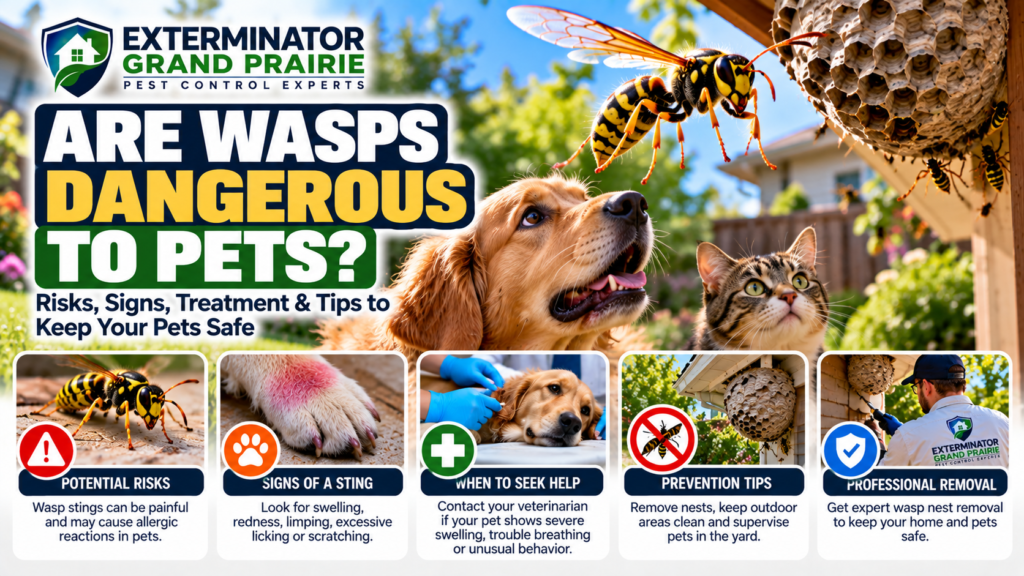
Yes. Wasps are a significant threat to pets in Grand Prairie TX yards, especially curious dogs and cats that snap at or paw at wasps.
Sting Risk to Pets
Pets can suffer anaphylaxis from wasp stings just as humans can — and they can’t tell you something is wrong. Warning signs in pets after a sting: facial swelling, vomiting, sudden lethargy, difficulty breathing, pale gums, and collapse. A pet that has been stung multiple times or shows any systemic reaction needs emergency veterinary care immediately.
Location of Stings on Pets
Pets are most commonly stung on the nose, mouth, and paws — areas with thin skin and high nerve density that cause intense pain. Stings inside the mouth or throat are especially dangerous as swelling can obstruct the airway.
Protection
If you have pets, ground-nesting yellow jacket colonies in your yard are a serious hazard. Dogs and cats may accidentally dig into or step on nest entrances. Professional nest elimination followed by perimeter treatment is the safest solution for pet-owning households.
Why Wasps Keep Returning to Your Yard
If wasps return every season despite your efforts, one or more of these factors is driving them back:
Pheromone Residue
Previous nests leave chemical signals that attract new queens to the same location every spring. Even after removing the visible nest, residue in wood fibers and soil persists for years. Professional residual insecticide treatment neutralizes these attractants.
Persistent Food Sources
An uncovered compost bin, fruit-bearing trees, outdoor pet food bowls, unsecured trash cans, and hummingbird feeders all provide reliable food for foraging wasps. Eliminating food sources reduces the attractiveness of your property.
Ideal Nesting Habitat
Properties with sheltered eaves, hollow walls, untreated wood, and landscaped grounds with ground cover provide everything a new queen needs. A professional can identify and treat specific nesting-risk areas.
Neighbors’ Nests
Wasps forage up to 1,000 feet from their nest. If your neighbors have an untreated nest, their wasps are visiting your property. Wasps don’t respect property lines — community-level management is sometimes necessary in dense residential areas like those in Grand Prairie.
The Solution
Professional perimeter treatments applied to eaves, soffits, and nest-prone surfaces in late spring (before new queens establish) dramatically reduce re-nesting. Combined with exclusion of entry points into wall voids and attic spaces, this breaks the annual cycle. Call (972) 755-0755 for a seasonal prevention plan tailored to your Grand Prairie property.
⚠️ Active Wasp Problem in Grand Prairie TX?
Don’t risk getting stung. Our licensed pest control team provides same-day wasp nest removal across Grand Prairie, Arlington, Irving, Mansfield, Duncanville, Cedar Hill, and all DFW communities.
(972) 755-0755 — Call Now for Same-Day Service
Related Pest Control Services in Grand Prairie TX
- Wasp Nest Removal Grand Prairie TX — Fast Same-Day Service
- Spider Control Grand Prairie TX
- General Pest Control Grand Prairie TX
- Mosquito Control Grand Prairie TX
- Pest Control Dallas TX
- Stink Bugs Invading Grand Prairie TX Homes
- Winter Pest Control Guide for Grand Prairie TX
Frequently Asked Questions About Wasp Control in Grand Prairie TX
How much does wasp nest removal cost in Grand Prairie TX?
Wasp nest removal in Grand Prairie TX typically costs $100 to $400. Accessible nests under eaves run $100–$150. Hidden nests inside wall voids or underground run $200–$400. Call (972) 755-0755 for a free estimate.
What time of year are wasps worst in Grand Prairie TX?
Wasp populations peak in Grand Prairie TX from August through October. Late summer colonies are at their largest and most aggressive. Yellow jacket activity typically extends into November during mild years.
Will wasps go away on their own in winter?
Worker wasps and colony queens die in winter in Grand Prairie TX. However, mated queens overwinter and build new nests in spring — often in the same location. Professional prevention treatment in spring stops re-establishment.
Is it safe to remove a wasp nest myself?
Consumer products can treat small, accessible paper wasp nests with 20–30 workers. Yellow jacket nests in wall voids or underground should never be treated without professional equipment. Disturbing a large colony without proper protection risks hundreds of stings — a potentially life-threatening situation.
How do I keep wasps from coming back every year?
Professional spring prevention treatment — applied to eaves, soffits, and previous nest sites before queens establish — significantly reduces annual re-nesting. Combined with sealing entry points and eliminating food sources, it breaks the returning-wasp cycle.