Bed Bug Control Grand Prairie TX — Complete Guide:
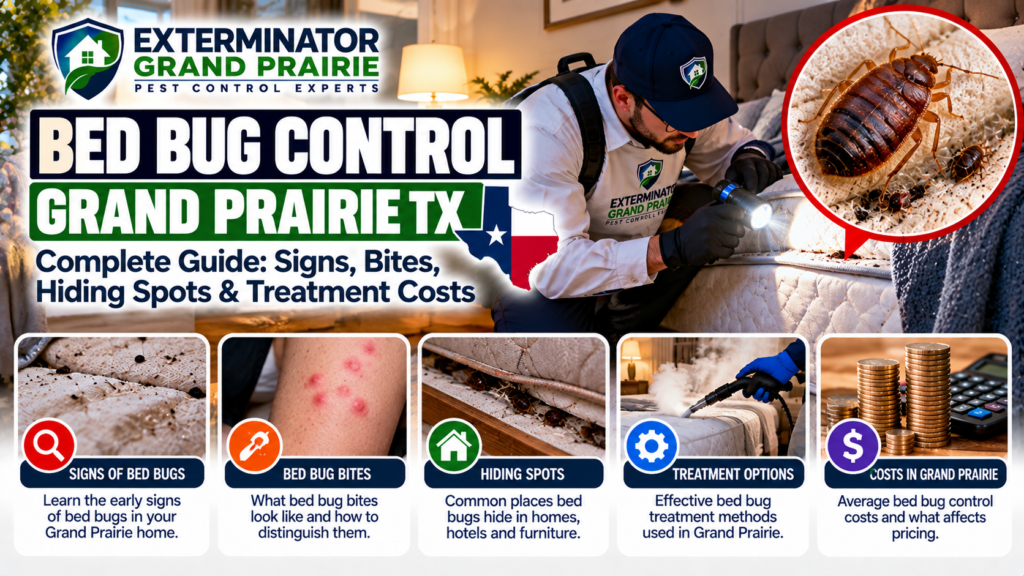
Bed bugs are one of the most stressful pest problems a Grand Prairie TX homeowner or renter can face. They are cryptic, resilient, and reproduce rapidly — a single missed female can restart an infestation weeks after treatment. This complete guide answers every question about bed bugs: how they enter your home, what the first signs look like, how much professional treatment costs, how to distinguish their bites from mosquitoes and fleas, exactly where they hide, and how fast they can spread through your home or apartment building.
If you suspect bed bugs, don’t wait early-stage infestations are dramatically easier and less expensive to treat. Call (972) 755-0755 for a same-day inspection in Grand Prairie TX.
How Do Bed Bugs Get Into Your Home?
Bed bugs do not fly, jump, or come in from the outdoors like most household pests. They are exclusive hitchhikers — every infestation starts with a bed bug that traveled on a person, their belongings, or used furniture. Understanding how they enter is the first step to preventing them.
Travel and Hotels
Hotels, motels, Airbnbs, and short-term rentals are the single most common source of bed bug introductions in Grand Prairie TX homes. Bed bugs congregate near sleeping areas. When a traveler sets a bag on an infested hotel bed or floor, bed bugs crawl inside and travel home with them. Always inspect hotel mattress seams and headboards on arrival, and store luggage on the luggage rack — never on the bed or floor.
Used and Secondhand Furniture
Upholstered furniture — mattresses, sofas, armchairs — purchased secondhand from thrift stores, Facebook Marketplace, estate sales, or left curbside carries significant bed bug risk. Bed bugs live deep in furniture seams, in tufts, and inside the wooden frame joints. Never bring a used mattress or upholstered sofa into your home without a thorough inspection under bright light. When in doubt, decline the item.
Guests and Visitors
A guest staying in your home who has an active infestation at their own residence can inadvertently carry bed bugs in their luggage, clothing, or personal items. Bed bugs at the infestation site often aggregate in luggage left near beds. This is a sensitive source to acknowledge, but it is a documented transmission route.
Multi-Unit Buildings
Apartment complexes, condos, and townhomes present a passive exposure risk — bed bugs can travel between units through wall voids, electrical conduit, and plumbing penetrations without any human carrier involved. In Grand Prairie TX apartment buildings, an infestation in one unit may spread to adjacent units within weeks without occupants doing anything differently.
Moving
Moving boxes, moving trucks used by multiple households, and furniture from a previous infested residence are all documented introduction pathways. Inspect belongings carefully before a move and consider professional heat treatment of high-risk items.
What Are the First Signs of Bed Bugs?
Catching a bed bug infestation early — when populations are low — makes treatment significantly more effective and affordable. These are the earliest indicators to look for:
Bite Marks on Skin
The first sign most people notice is unexplained bites on the body when waking up — typically on exposed skin: arms, neck, shoulders, and face. Bed bug bites appear as small, red, raised welts, often in a linear or clustered pattern (commonly described as “breakfast, lunch, dinner” — three bites in a row). However, approximately 30% of people show no skin reaction to bed bug bites at all, making bites an unreliable sole indicator.
Blood Stains on Sheets and Pillowcases
Small rust-colored or brown spots on sheets, pillowcases, and mattress covers are caused by bed bugs being accidentally crushed during sleep, or by blood seeping from a bite site. These spots are often found near the edges and corners of the mattress and along sheet seams.
Dark Fecal Spots
Bed bug fecal matter appears as tiny dark brown or black spots — similar in size to a period at the end of a sentence. Unlike blood stains, fecal spots absorb into fabric and do not smear when rubbed. They accumulate along mattress seams, in headboard crevices, along baseboards, and behind electrical outlet covers.
Shed Skins (Exuviae)
Bed bugs molt five times as they grow from nymph to adult, shedding their exoskeleton at each stage. Pale, translucent shed skins accumulating in hiding spots are a strong indicator of an established, actively growing population. Finding shed skins means the infestation has been present long enough for multiple generations to mature.
Live Bugs
Adult bed bugs are visible to the naked eye — approximately the size and shape of an apple seed, flat and oval, reddish-brown (becoming darker and more swollen after feeding). Nymphs are much smaller and nearly translucent. Inspect mattress seams, box spring fabric, headboard joints, and nearby furniture with a bright flashlight.
Musty Odor
Large infestations produce a distinctive sweet, musty odor — sometimes described as overripe raspberries or almonds — caused by bed bug pheromones. A noticeable musty smell in the bedroom without another explanation is worth investigating further.
How Much Does Bed Bug Treatment Cost in Texas?
Bed bug treatment costs in Texas vary significantly based on the treatment method, the size of the infestation, and the number of rooms affected. Here are realistic price ranges for Grand Prairie TX homeowners:
Chemical Treatment (Residual Spray)
Chemical treatment using residual insecticides is the most common approach. A single-room treatment runs $200–$400. Whole-home treatment for a standard 3-bedroom Grand Prairie home typically costs $400–$1,000, usually requiring 2–3 follow-up visits at 2-week intervals. Chemical treatment requires significant prep work by the homeowner and does not kill eggs — follow-up visits are essential.
Heat Treatment
Whole-room or whole-home heat treatment raises the temperature to 120–135°F, killing all life stages including eggs in a single treatment. Cost in the Grand Prairie TX market runs $1,000–$2,500 for a standard home. Heat treatment is more expensive upfront but typically eliminates the infestation in one visit with no prep work and no chemical exposure. It is the preferred method for severe or whole-home infestations.
Bed Bug Extermination with Dog Inspection
Canine bed bug detection inspections — using trained scent-detection dogs — cost $200–$400 for a home inspection. Dogs detect live bugs and viable eggs with significantly higher accuracy than visual inspection. In apartment buildings with multiple units, canine inspections identify exactly which units are infested, reducing unnecessary treatment costs.
What Affects the Final Cost
Clutter level (more clutter means more hiding spots and more prep time), number of infested rooms, severity of the infestation, and the selected treatment method all affect final cost. An early-stage infestation treated in one or two rooms costs a fraction of a severe whole-home infestation. Every week of delay allows the population to grow and the cost to increase. Call (972) 755-0755 for a free inspection and written estimate.
Bed Bug Bites vs Mosquito Bites: What’s the Difference?
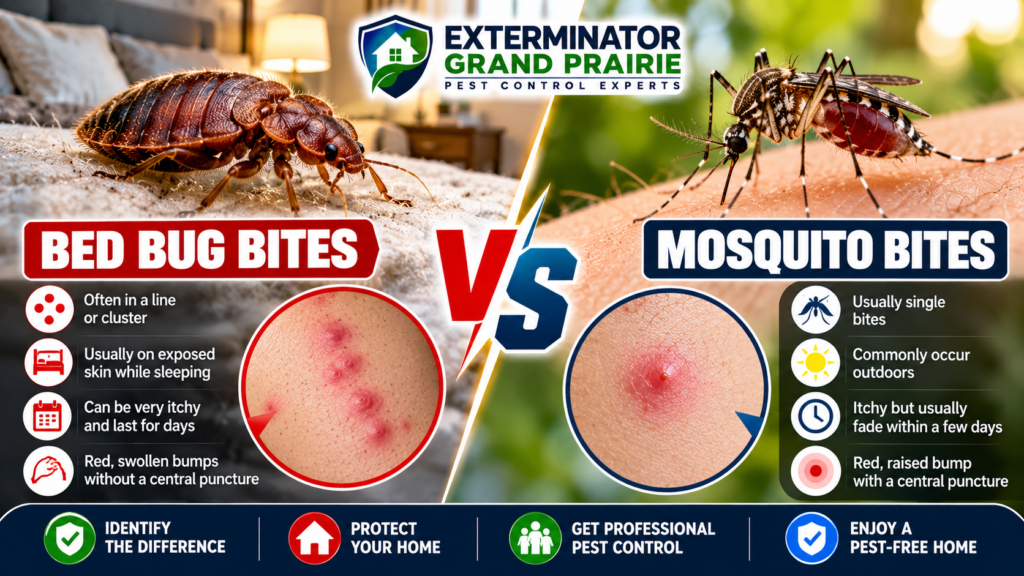
Bed bug bites and mosquito bites are frequently confused — both produce small, red, itchy welts. These differences help distinguish them:
Pattern and Arrangement
Bed bug bites typically appear in a linear or clustered pattern — multiple bites in a row or group, often called the “breakfast, lunch, dinner” pattern, reflecting a single bed bug feeding along a line of exposed skin. They concentrate on areas exposed during sleep: arms, neck, shoulders, face, and upper chest.
Mosquito bites appear as single, random, scattered welts — wherever the mosquito landed. They are more evenly distributed across the body with no particular pattern.
Timing of Reaction
Bed bug bites may not appear immediately — some people develop visible welts 1–3 days after being bitten, while others show no reaction at all. The delayed reaction is why many people don’t connect the bites to their sleeping environment.
Mosquito bites typically develop a raised, itchy welt within minutes of the bite. The reaction is immediate and unmistakable in most people.
Location of Exposure
Bed bug bites occur exclusively during sleep or prolonged rest on infested furniture. If bites consistently appear overnight but never during outdoor activity, bed bugs are more likely.
Mosquito bites occur during outdoor exposure or near windows and doors at dusk and dawn. If bites appear after outdoor activity or in the evening near unscreened windows, mosquitoes are more likely.
Welt Appearance
Mosquito bites tend to have a raised, puffy center that subsides within hours. Bed bug bites often produce a harder, flatter welt with a darker red center that persists for several days to a week.
Bed Bug Bites vs Flea Bites: How to Tell Them Apart
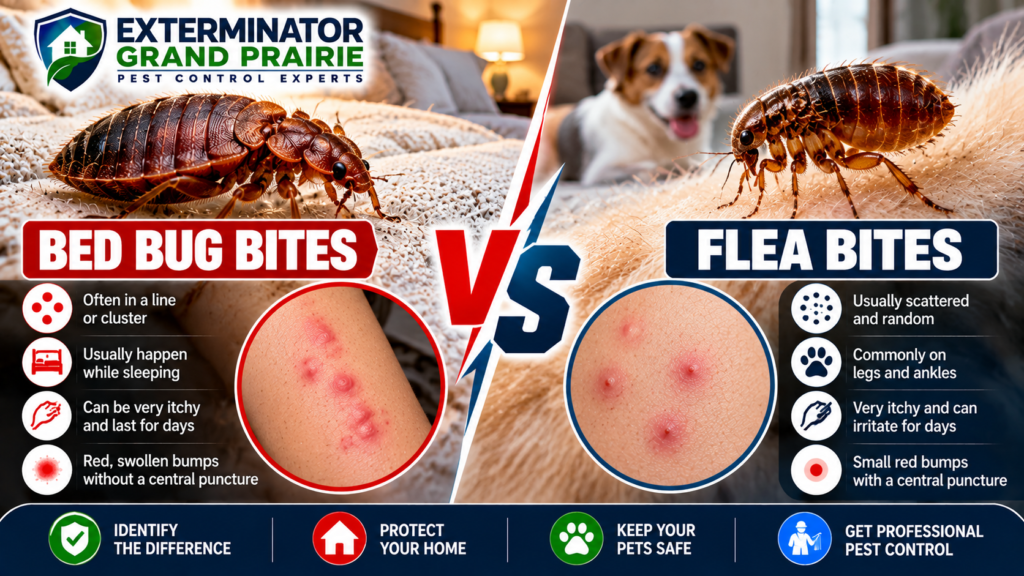
Both bed bugs and fleas bite while a person is at rest, making them easy to confuse. Key differences:
Location on the Body
Flea bites are concentrated on the lower body — ankles, lower legs, and feet — because fleas jump from floor level and carpeting. They rarely bite above the waist unless a person is lying on infested bedding.
Bed bug bites concentrate on upper body areas exposed during sleep — arms, neck, shoulders, and face. If bites are consistently above the waist and appear overnight, bed bugs are more likely.
Bite Appearance
Flea bites are very small with a distinctive red halo around the central puncture mark. They are intensely itchy immediately and often blister. Multiple bites frequently appear in irregular clusters on the lower legs.
Bed bug bites are slightly larger, flat or slightly raised welts without a distinctive halo. They tend to appear in lines or grouped clusters rather than random scatter.
Pets
If household pets are scratching and biting themselves, fleas are significantly more likely than bed bugs. Bed bugs rarely infest or feed on dogs and cats — they strongly prefer human hosts. Flea bites on humans almost always coexist with flea activity on pets.
Time of Biting
Bed bugs feed primarily between 2 and 5 a.m. — their peak activity window when hosts are in deep sleep. Fleas bite opportunistically whenever they contact a host, including during waking hours if a person sits or lies on infested carpeting or furniture.
What Do Bed Bug Eggs Look Like?
Bed bug eggs are one of the most important things to identify during an inspection — they are not killed by many insecticides, and a single surviving egg can restart an infestation.
Appearance
Bed bug eggs are tiny — approximately 1mm long, about the size of a pinhead. They are pearl-white or translucent white, elongated and oval-shaped, slightly curved, and have a distinct cap-like structure at one end (the operculum, through which the nymph hatches). Under magnification, older eggs (more than 5 days old) show a visible dark eye spot as the embryo develops.
Where They Are Found
Females glue eggs to rough surfaces near feeding sites using a clear, sticky secretion that makes them very difficult to dislodge. Common egg locations include mattress seams and tufts, box spring fabric folds, headboard joints and crevices, behind the headboard where it meets the wall, along baseboards directly behind the bed, and inside electrical outlet covers near the sleeping area.
How Many Eggs
A female bed bug lays 1–5 eggs per day and 200–500 over her lifetime. Eggs hatch in 6–10 days at room temperature. This rapid reproductive rate means a small infestation can become severe within 2–3 months if untreated — a compelling reason to act at the first sign of bed bug activity.
Where Do Bed Bugs Hide During the Day?
Bed bugs are nocturnal feeders that retreat to harborage sites during daylight hours. Finding their hiding spots is essential to effective treatment. They prioritize proximity to their host and darkness.
Primary Hiding Spots (Within 5 Feet of the Bed)
- Mattress seams, tufts, and labels — the most common primary harborage in early infestations
- Box spring interior and fabric folds — the fabric lining underneath is a classic hiding zone
- Headboard — behind it, in joints and crevices, and in screw holes
- Bed frame joints and hollow legs
- Nightstand drawers, joints, and the underside
Secondary Hiding Spots (As Infestation Grows)
- Baseboards and the gap between baseboard and floor
- Behind wall outlets and switch plates
- Inside picture frames hanging near the bed
- In the folds of curtains and drapes
- Under carpet edges near the wall
- Inside upholstered furniture — sofa seams, chair tufts, recliners
- Inside electronics (alarm clocks, televisions) left near the bed
- Behind loose wallpaper and wall art
A professional inspection uses a combination of visual examination and specialized detection tools to find harborage sites that a DIY inspection routinely misses. Call (972) 755-0755 for a thorough inspection in Grand Prairie TX.
Can Bed Bugs Live in Your Mattress?
Yes — a mattress is the most common primary harborage for bed bugs in an early infestation. The mattress seams, tufts, label area, and inner piping provide exactly the tight, dark, close-to-host hiding sites bed bugs require.
How Deep Do They Go?
Bed bugs do not typically penetrate deep into the mattress foam or fill in the early stages of an infestation — they stay in and around the seams and fabric folds of the outer mattress cover. In severe, long-term infestations, they can be found deeper inside if the mattress cover is torn or damaged.
Does a Mattress Encasement Help?
A bed bug-certified mattress encasement (a zippered cover that fully encloses the mattress) serves two purposes: it traps any bed bugs already living in the mattress, starving them over time, and it creates a smooth surface on the outside that gives bed bugs no seams to hide in. Mattress encasements are a recommended component of bed bug treatment but are not a substitute for professional treatment — bed bugs in the rest of the room will still feed and breed regardless of the encasement.
Should You Throw Away an Infested Mattress?
Professional heat treatment can eliminate bed bugs from an infested mattress without discarding it. Throwing away a mattress without treating the room first will not resolve the infestation — the remaining bugs will simply disperse to other hiding spots. If you do discard a mattress, cut or mark it clearly as infested before placing it for collection to prevent others from taking it home.
Can Bed Bugs Live in Pillows?
Yes, though pillows are a secondary harborage rather than a preferred hiding spot. Bed bugs are more commonly found in mattress seams and the box spring than inside or on pillows. However, in more established infestations they do colonize pillow surfaces, seams, and the interior of pillows — particularly those without pillow protectors.
Signs of Bed Bugs in Pillows
Check the seams and corners of pillowcases and pillow covers for fecal spots, blood stains, and shed skins. Unzip the pillow protector and inspect the pillow itself along seam lines. In a significant pillow infestation, a musty odor may be detectable when the pillow is pressed.
What to Do
Wash pillows and pillowcases in hot water (at least 120°F) and dry on the highest heat setting for 30 minutes — the heat kills all life stages including eggs. Pillow protectors certified for bed bugs provide the same benefit as mattress encasements. Do not discard pillows during an active infestation without treating the room — the infestation source remains regardless.
Can Bed Bugs Live in Clothes?
Bed bugs can hide in clothing, but it is not their preferred harborage — they prefer stationary locations close to sleeping humans rather than items that are moved, worn, and laundered regularly. However, clothing left on the floor, in laundry piles, or folded in drawers near an infestation can harbor bed bugs.
The Clothing Risk
Clothing left on the floor next to an infested bed, or stored in a bedroom with an established infestation, can serve as a temporary refuge and a transport mechanism — carrying bed bugs to another room, a car, a workplace, or another person’s home. This is one mechanism by which infestations spread between rooms and to new locations.
How to Treat Clothing
Wash infested clothing in the hottest water the fabric tolerates, then dry on the highest heat setting for at least 30 minutes. Heat above 120°F kills all life stages. For items that cannot be washed — shoes, structured handbags, dry-clean-only garments — seal them in a black plastic bag and leave them in a hot car or in the sun for several hours (interior temperatures must reach 120°F, which is achievable in a Texas summer). A professional pest control service can also treat clothing storage areas as part of a room treatment.
Can Bed Bugs Live in Your Car?
Yes — bed bugs can survive in a car, though vehicles are not a typical infestation site. A car infestation almost always begins as a secondary spread from an infested home, luggage, or clothing placed in the vehicle.
Where They Hide in Cars
Seat seams, seat crevices, under seat tracks, in headliner fabric, inside door pockets, and in trunk carpeting are the most likely hiding spots. Bed bugs in cars are most common when infested luggage or clothing has been transported, or when a car regularly carries a person from a heavily infested location.
How to Treat a Car
Vacuum all upholstery and surfaces thoroughly, paying attention to seams and crevices. Steam cleaning with a commercial steamer (temperatures above 120°F at the surface) kills all life stages on contact. In a Texas summer, a car parked in direct sun with windows closed can reach interior temperatures of 130–160°F — leaving a car sealed in direct summer sun for 2–3 hours can serve as a passive heat treatment for the vehicle interior. Professional portable heat treatment is also available for vehicles.
Signs of Bed Bugs in Your Car
Finding small reddish-brown insects, dark fecal spots on seat fabric, or shed skins in seat crevices are indicators of car bed bug activity. Unexplained bite marks appearing after time spent in the car are also a warning sign.
How Fast Do Bed Bugs Spread?
Bed bugs spread faster than most homeowners expect — the timeline from a small, manageable infestation to a severe whole-home problem can be measured in months, not years.
Reproductive Rate
A single mated female bed bug lays 1–5 eggs per day. Eggs hatch in 6–10 days. Nymphs reach reproductive maturity in approximately 5–6 weeks under favorable conditions (warm temperatures and regular access to a host). Within 3 months, a single founding female can produce 3 generations and hundreds of offspring. Within 6 months, a small infestation can grow to thousands of individuals across multiple rooms.
Physical Spread Through a Home
Bed bugs spread from an initial harborage site (typically the bedroom) by traveling along walls, through electrical conduit, under baseboards, and through gaps in flooring. They are attracted to the carbon dioxide exhaled by sleeping humans and will travel up to 20 feet in a single night to feed. In a home where the infestation is allowed to grow, bugs spread to adjacent bedrooms, living room furniture, and eventually throughout the structure.
The Cost of Waiting
An early-stage infestation of 20–50 bugs in a single room can be treated for $200–$400 and resolved in 2–3 visits. A severe infestation of thousands spread across multiple rooms requires heat treatment or multiple chemical treatments at $1,000–$2,500. Every month of delay compounds both the difficulty and the cost of treatment. Call (972) 755-0755 to schedule an inspection before the infestation spreads.
Can Bed Bugs Move Between Apartments?

Yes — bed bug spread between apartment units is one of the most significant and difficult aspects of multi-unit housing infestations. It is also one of the most common sources of frustration for renters who treat their unit and are re-infested within weeks.
How They Travel Between Units
Bed bugs exploit the continuous void spaces that connect apartment units in multi-family buildings: wall voids running between units, gaps in drywall around electrical outlets and plumbing penetrations, under baseboards, through plumbing chases, and via shared laundry facilities and hallways. A bed bug does not need a large opening — they can compress through a gap approximately the thickness of a credit card.
The Re-Infestation Problem
A renter who treats their unit without the adjacent units also being inspected and treated faces near-certain re-infestation from neighboring units with active infestations. This is why self-treating with store-bought sprays rarely resolves apartment bed bug problems — the source infestation in an adjacent unit continues to supply new bugs.
Tenant Rights and Landlord Obligations in Texas
Under Texas Property Code, landlords are required to make a dwelling habitable and to remedy conditions that materially affect the health or physical safety of residents. A bed bug infestation may qualify as such a condition depending on its severity and documentation. Renters should document the infestation in writing, report it to the landlord in writing, and request professional treatment as a formal maintenance request. A professional inspection report documenting the infestation supports tenant claims. Call (972) 755-0755 for an apartment bed bug inspection in Grand Prairie TX.
Can Bed Bugs Live Without Feeding?
Yes — bed bugs are remarkably resilient survivors, capable of surviving extended periods without feeding. This is one of the reasons they are so difficult to eliminate without professional treatment.
Survival Without a Host
Adult bed bugs can survive 6–12 months without feeding under typical room-temperature conditions (70–80°F). In cooler environments, their metabolism slows further and survival extends even longer — some studies document survival beyond 18 months in cool conditions. Nymphs can survive 3–4 months without feeding, depending on their developmental stage.
Why This Matters
Leaving a home vacant or sleeping elsewhere will not resolve a bed bug infestation — the bugs simply enter a dormant state and wait for a host to return. This also means that bed bugs brought into a home on used furniture may have been waiting in that furniture for months with no previous feeding opportunity.
Implications for Treatment
Heat treatment is the only method that kills all life stages immediately regardless of feeding status. Chemical treatments require contact with live bugs over multiple visits, and surviving bugs in deep harborage can avoid contact with treated surfaces. For severe infestations or situations requiring guaranteed one-visit elimination — a property sale, a lease transfer — heat treatment is the superior option. Call (972) 755-0755 to discuss the right treatment approach for your Grand Prairie TX property.
🛏️ Bed Bugs in Grand Prairie TX? Don’t Wait.
Early-stage infestations are dramatically easier and less expensive to treat. Our licensed technicians provide same-day bed bug inspection, heat treatment, and chemical treatment across Grand Prairie, Arlington, Irving, Mansfield, Duncanville, Cedar Hill, and all DFW communities.
(972) 755-0755 — Free Inspection & Estimate
Related Pest Control Services in Grand Prairie TX
- Bed Bug Control Grand Prairie TX — Heat Treatment & Chemical Treatment
- General Pest Control Grand Prairie TX
- Spider Control Guide for Grand Prairie TX
- Wildlife Removal Guide for Grand Prairie TX
- Wasp Control Guide for Grand Prairie TX
- Fall Pest Prevention for Grand Prairie TX Homes
Frequently Asked Questions About Bed Bug Control in Grand Prairie TX
How much does bed bug treatment cost in Grand Prairie TX?
Bed bug treatment in Grand Prairie TX costs $200–$400 per room for chemical treatment, or $1,000–$2,500 for whole-home heat treatment. Heat treatment eliminates all life stages in one visit. Chemical treatment requires 2–3 follow-up visits. Call (972) 755-0755 for a free inspection and written estimate.
What are the first signs of a bed bug infestation?
The first signs are unexplained bite marks in linear or clustered patterns on arms, neck, and shoulders when waking; small rust-colored blood spots on sheets; dark fecal spots along mattress seams; pale shed skins in mattress folds; and — in severe cases — a sweet musty odor in the bedroom.
How do I know if I have bed bugs or fleas?
Flea bites concentrate on the lower legs and ankles and coexist with scratching pets. Bed bug bites concentrate on the upper body (arms, neck, shoulders) and appear in lines or clusters. Bed bugs do not infest pets. If your pets are scratching, check for fleas first. If bites appear on the upper body during sleep without pet involvement, inspect the mattress seams for bed bugs.
Can bed bugs live in furniture other than the bed?
Yes. As an infestation grows, bed bugs spread to sofas, armchairs, nightstands, dressers, baseboards, and even inside electronics near the sleeping area. Treating only the mattress while leaving surrounding furniture untreated will not resolve an established infestation.
How fast do bed bugs multiply?
A single mated female lays 1–5 eggs per day. Eggs hatch in 6–10 days. Nymphs reach maturity in 5–6 weeks. Within 3 months, one female can produce hundreds of offspring across multiple generations. Early treatment is essential — every month of delay compounds the difficulty and cost.
Can I get rid of bed bugs myself?
Consumer bed bug sprays and “bombs” are rarely effective against established infestations — they do not penetrate into harborage sites and do not kill eggs. Heat is the only method that reliably kills all life stages. DIY heat treatments (space heaters, hair dryers) cannot achieve the sustained 120°F temperature throughout a room required for complete elimination. Professional treatment is strongly recommended for any confirmed infestation.
How long does bed bug treatment take?
Heat treatment takes approximately 6–8 hours per treatment area, with results confirmed in one visit. Chemical treatment requires a 2–4 hour initial treatment plus 2–3 follow-up visits over 4–6 weeks. You can remain in your home after chemical treatment (following product-specific re-entry intervals). Heat treatment may require vacating the home for the treatment day.